Student Resources
See Master Harden explain the first white belt form Chon Ji.
Chon-Ji
Meaning: "Chon-Ji means literally 'the Heaven the Earth'. It is, in the Orient, interpreted as the creation of the world or the beginning of human history, therefore, it is the initial pattern for the white belt advancement to the gold belt level.
Chon Ji is the foundational form, or pattern, taught to beginner martial arts students, marking the official start of their training journey. The name literally translates to "Heaven and Earth," symbolizing the creation of the universe and representing the student at the very beginning of their path, ready to be molded. This nineteen-movement sequence is performed in a cross shape on the floor and is designed to instill essential basics, focusing on strong, stable stances, correct breathing, and the execution of fundamental blocks and powerful punches. Mastering the simplicity and precision of Chon Ji is crucial, as it lays the necessary groundwork in balance, coordination, and discipline for all complex techniques that follow.


Tan Gun
The Foundation of a Nation
Legendary Origins & Rising Power
Tan Gun (or Dan-Gun) is named after the holy Dan-Gun, the legendary founder of Korea in the year 2333 B.C. Just as Chon-Ji represented the creation of the world, Tan Gun represents the next step in history: the establishment of a society. This progression is mirrored in the student's journey; having mastered the basics, they are now building the structure of their martial arts identity. The form consists of 21 movements, representing the early strength and stability of the new nation.
Physically, Tan Gun introduces a higher level of challenge and aggression. While previous forms may focus on middle-section attacks, Tan Gun is characterized by a series of high-section punches aimed at eye level. This forces the student to raise their sights and posture, symbolizing the scaling of a mountain. It also introduces the "Twin Forearm Block," a powerful defensive move that requires significant coordination and core strength, teaching the student to defend against multiple angles of attack simultaneously.


Do-San
Do-San (often romanized as To-San) is the form named after the patriot Ahn Chang-Ho (1878–1938), who devoted his entire life to furthering the education of Korea and its independence movement. The 24 movements in this pattern represent his entire life, which he dedicated to furthering the education of Korea and its independence movement. This form introduces more complex techniques, specifically the outer forearm wedging block and the straight spear fingertip thrust, teaching students to defend against grabs and attack vital points with precision. The faster pace and combination of techniques symbolize the rising tempo of the independence movement and the student's growing agility and power


Won-Hyo
Won-Hyo: The Monk's Path
Spiritual Strength & Circular Power
Won-Hyo is named after the noted monk who introduced Buddhism to the Silla Dynasty in the year 686 A.D. The form consists of 28 movements, and unlike the previous patterns which focus heavily on rigid, linear attacks, Won-Hyo introduces more fluid, circular defensive motions. This represents the student's growing maturity; they are learning that strength is not just about clashing force against force, but also about deflecting and redirecting energy.
Technically, Won-Hyo is a significant step up in difficulty. It introduces the "Fixed Stance" (Go-Jung Sogi), which distributes weight 50/50 and allows for powerful side-to-side defense. It also features the "Circular Block," a sophisticated technique that requires the student to use a large, sweeping motion to intercept a kick. This form also marks the first time a student performs a "Bending Ready Stance"—a balance technique where the student prepares for a side kick while balancing on one leg, demanding superior core strength and focus.
Belt Test Recitation
Meaning: "Won-Hyo was the noted monk who introduced Buddhism to the Silla Dynasty in the year 686 A.D."
Number of Movements: 28


Yul-Gok
Yul-Gok: The Scholar’s Wisdom
Philosophy & Controlled Power
Yul-Gok is the pseudonym of the great philosopher and scholar Yi I (1536–1584), who is often called the "Confucius of Korea." Just as Yi I was a man of deep intellect, this form requires the student to demonstrate a higher level of mental focus and technical understanding. The 38 movements of this pattern refer to his birthplace on the 38th degree latitude, and the diagram represents the Chinese character for "scholar."
Physically, Yul-Gok is designed to teach stability and precision. It introduces the concept of "Connecting Motion," where two techniques are performed in a single breath with a single sine wave, requiring excellent breath control. The form also features the "Hooking Block," a technique used to catch an opponent's attack, and the powerful "Front Elbow Strike," which teaches the student to generate force at close range. Perhaps most notably, the form emphasizes measuring distance, with students extending a hand to gauge the gap before launching a punch, symbolizing the scholar's careful calculation before taking action.
Belt Test Recitation
Meaning: "Yul-Gok is the pseudonym of a great philosopher and scholar Yi I (1536-1584) nicknamed the 'Confucius of Korea'. The 38 movements of this pattern refer to his birthplace on the 38th degree latitude and the diagram represents 'scholar'."
Number of Movements: 38

Joong-Gun
Joong-Gun: The Patriot’s Sacrifice
Precision & Control
Joong-Gun is named after the patriot Ahn Joong-Gun, a seminal figure in Korean history who assassinated Hiro-Bumi Ito, the first Japanese governor-general of Korea. This act was a pivotal moment in the struggle for independence. The form consists of 32 movements, which represent Mr. Ahn’s age when he was executed in the Lui-Shung prison in 1910.
Physically, Joong-Gun marks a significant shift in training. It is the first form to introduce "slow motion" techniques, specifically the pressing blocks and the angle punch. These movements require the student to demonstrate immense core strength and balance, moving with deliberate slowness to show total control over their body. The form also introduces the "U-Shape Block," a unique defensive technique performed in a fixed stance where the practitioner uses a pole-holding shape to block a weapon attack, symbolizing the ability to catch and neutralize a threat.
Belt Test Recitation
Meaning: "Joong-Gun is named after the patriot Ahn Joong-Gun who assassinated Hiro-Bumi Ito, the first Japanese governor-general of Korea, known as the man who played the leading part in the Korea-Japan merger. There are 32 movements in this pattern to represent Mr. Ahn's age when he was executed at Lui-Shung prison (1910)."
Number of Movements: 32


Toi-Gye
Toi-Gye: The Scholar’s Authority
Inner Strength & Fluid Defense
Toi-Gye is the pen name of the noted scholar Yi Hwang (16th century), an authority on neo-Confucianism. The 37 movements of the pattern refer to his birthplace on the 37th latitude, and the diagram represents "scholar." Just as the previous form (Yul-Gok) was named after the "Confucius of Korea," this form honors another intellectual giant, signaling that the student is now refining their mental understanding of the art as much as their physical technique.
Physically, Toi-Gye introduces unique, fluid defenses that differ from the rigid blocks of earlier forms. The signature technique is the "W-Shape Block" (San Makgi), a powerful movement used to clear space and protect the head from a grab or double attack. This form also features the "Upset Fingertip Thrust," a precise strike to the groin, and the "Knee Kick," which teaches the student to pull an opponent into a strike rather than just reaching out to hit them. These movements require the student to master the transition between relaxation and tension, generating power through a "snap" rather than brute force.
Belt Test Recitation
Meaning: "Toi-Gye is the pen name of the noted scholar Yi Hwang (16th century), an authority on neo-Confucianism. The 37 movements of the pattern refer to his birthplace on the 37th latitude, the diagram represents 'scholar'."
Number of Movements: 37


Kwant-Gae
Kwang-Gae: The Expander of Territory
Expansion & Recovery
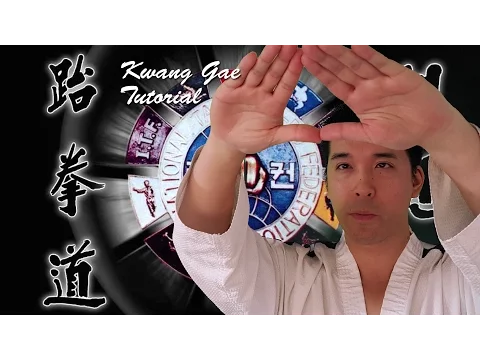
Kwang-Gae is named after the famous Gwanggaeto the Great (374–413 A.D.), the 19th King of the Goguryeo Dynasty, who regained all the lost territories including the greater part of Manchuria. The diagram of the form represents the expansion and recovery of lost territory. The 39 movements refer to the first two figures of 391 A.D., the year he came to the throne.
Physically, this form is distinct because it begins with "Heaven Hands" (a circular motion bringing the hands together above the head), symbolizing the gathering of energy. It is famous for its slow-motion techniques, particularly the upset punches and the high hooking blocks, which test the Black Belt's ability to generate power without relying on speed alone. It also introduces complex footwork like the "Double Stepping" motion and the "Shift," teaching the practitioner how to cover ground quickly and fluidly to close the gap on an opponent.
Belt Test Recitation
Meaning: "Kwang-Gae is named after the famous Kwang-Gae-Toh-Wang, the 19th King of the Koguryo Dynasty, who regained all the lost territories including the greater part of Manchuria. The diagram represents the expansion and recovery of lost territory. The 39 movements refer to the first two figures of 391 A.D., the year he came to the throne."
Number of Movements: 39